In the pharmaceutical and veterinary drug raw material markets, the price trend of lincomycin hydrochloride has always drawn significant attention. As a broad-spectrum antibiotic, lincomycin hydrochloride holds a crucial position in both clinical treatment and livestock/poultry farming. In recent years, its price has shown a remarkable upward trend, with various indicators suggesting this trend will continue in the future and may even break through historical highs.
Over the past three years, the price of lincomycin hydrochloride has fluctuated significantly:
- In 2022, the price ranged roughly between 270-320 yuan per billion units. The price trended gradually downward in the first three quarters, hitting a low of 270 yuan per billion units in September, before starting to rise in the fourth quarter.
- In 2023, prices remained relatively stable within a narrow range. However, a notable change occurred in 2024:
- In Q1, transaction prices ranged between 293-305 yuan per billion units.
- In Q2, prices rose gradually, with an average of 306 yuan per billion units. By June, the market saw a sharp surge, with trading volume increasing rapidly and prices of all brands breaking through 300 yuan per billion units.
- In 2025, the price increase has been even more rapid. According to market monitoring data, the current quotations from mainstream manufacturers have reached 470 yuan per billion units, a year-on-year increase of over 35%.
The three-year trend shows that after a period of relatively stable fluctuations, the price of lincomycin hydrochloride entered a rapid upward trajectory starting in 2024.
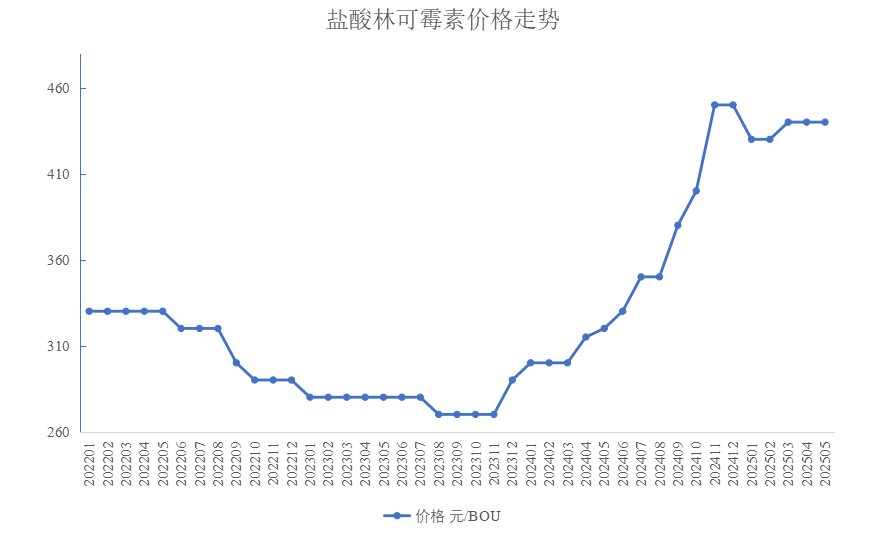
图.近3年以来盐酸林可霉素原药价格走势
Veterinary Medicine Sector: With the implementation of the ban on nitroimidazole drugs by the Ministry of Agriculture and Rural Affairs, lincomycin has become the primary alternative for preventing and controlling anaerobic infections. In livestock and poultry farming, summer is a high-incidence period for diseases, leading to a surge in demand for preventive and therapeutic drug stockpiling. Taking the summer of 2025 as an example, demand for veterinary-grade lincomycin increased by over 40% year-on-year.
In terms of farming scale, the degree of large-scale farming has continuously improved in recent years, with large farming enterprises and groups gradually becoming the market mainstay. These large-scale farms raise enormous numbers of livestock and poultry, and any epidemic can cause huge losses, making their demand for disease prevention and treatment drugs more urgent and concentrated. For instance, a pig farming enterprise with an annual output of 1 million pigs may purchase dozens of times more lincomycin hydrochloride than small farms during high-disease periods. Meanwhile, farmers’ requirements for drug efficacy and safety are also increasing, and lincomycin hydrochloride has become the first choice for many farms due to its excellent control effect on anaerobic bacteria.
From the perspective of the farming cycle, disease prevention and control are required throughout the entire breeding cycle of livestock and poultry, from seedlings to slaughter. Especially during critical growth stages such as piglet weaning and poultry brooding, when immunity is relatively low and more susceptible to bacterial infections, the demand for lincomycin hydrochloride is more vigorous. Concentrated procurement by numerous farms has caused market demand for lincomycin hydrochloride to expand rapidly in the short term, becoming one of the direct drivers of price increases.
Pharmaceutical Market: Clindamycin series products (such as dispersible tablets and granules) have maintained steady growth in clinical demand due to their unique efficacy against Gram-positive bacteria and anaerobic bacteria. With the continuous growth of the global population, especially the rapid increase in population in developing countries, the demand for various pharmaceuticals has also been rising. At the same time, population aging has 加剧 (exacerbated) the situation, as older adults are more prone to various infectious diseases due to declining physical functions, leading to relatively high frequency and dosage of antibiotic use, which further stimulates demand for lincomycin hydrochloride.
In terms of improved medical standards, with the advancement of diagnostic techniques, more infectious diseases can be timely detected and diagnosed, thereby increasing the use of antibiotics. Additionally, in grassroots medical markets and developing regions with relatively limited medical resources, lincomycin hydrochloride, as a cost-effective antibiotic, plays an important role in meeting basic medical needs. Take some African countries as an example: where medical systems are underdeveloped, lincomycin hydrochloride has become a commonly used drug for treating common infectious diseases due to its moderate price and proven efficacy, with sustained demand growth in local markets. This steady and continuous growth in pharmaceutical market demand has strongly supported and driven the price of lincomycin hydrochloride.
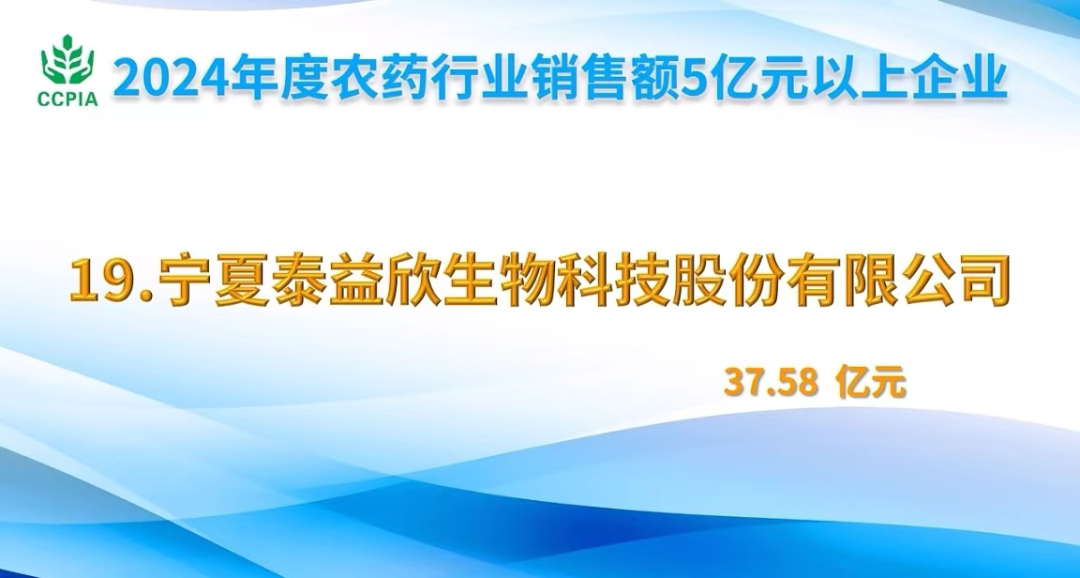
Production Capacity Bottlenecks: The global lincomycin hydrochloride API market is highly concentrated. Although domestic leading producers such as Ningxia Taiyixin Biotech, Yichang Dongyangguang Pharmaceutical, and Tianfang Biotech have occupied more than 75% of the global market share through technological breakthroughs, and their key product quality indicators (such as impurity B content controlled below 0.7%, significantly better than industry standards), these enterprises still face severe production capacity bottlenecks.
From a manufacturing process perspective, the production of lincomycin hydrochloride involves complex fermentation processes and multiple purification steps, resulting in a long production cycle. For example, a complete fermentation cycle typically takes several days, and requires extremely strict control of fermentation conditions such as temperature, pH, and dissolved oxygen; even minor fluctuations in any parameter can affect product quality and yield. Additionally, the high cost of upgrading and maintaining production equipment—new equipment requires significant capital investment and retraining of operators—limits enterprises’ ability to rapidly expand capacity in the short term.
From a market order perspective, orders have been scheduled through July 2025, and existing capacity is far from meeting surging market demand. Even if enterprises have capacity expansion plans, the entire process from project planning, land approval, and factory construction to equipment installation, debugging, and personnel recruitment and training often takes years to achieve production. Moreover, during construction, enterprises may face many uncertainties such as raw material price fluctuations and changes in environmental policies, further prolonging the capacity expansion cycle and making it impossible to alleviate supply tensions in the short term.
Low Inventory Levels: Due to the long-term growth rate of market demand exceeding that of capacity expansion, inventories of lincomycin hydrochloride are at historic lows. In the past, enterprises typically managed production and inventory based on historical market demand patterns, but the explosive growth in market demand in recent years has disrupted the original supply-demand balance.
From an inventory management strategy perspective, enterprises often adopt lean inventory management models to reduce inventory costs, maintaining low inventory levels. However, when market demand surges unexpectedly, this low-inventory strategy leaves enterprises unable to timely meet market demand. At the same time, unstable raw material supply also affects enterprises’ ability to replenish inventory. For example, the supply of major raw materials such as starch and soybean cake powder is affected by multiple factors such as agricultural production seasons, natural disasters, and international trade policies, with frequent price fluctuations and unstable supply, making it difficult for enterprises to timely adjust production plans and replenish inventory according to market demand. In the current market environment, low inventory means that once demand fluctuates or grows unexpectedly, enterprises cannot meet market needs through inventory adjustments and can only balance supply and demand by raising prices.
With the advancement of the "dual carbon" (carbon peaking and carbon neutrality) goals, API manufacturers face higher environmental compliance costs. The production of lincomycin hydrochloride involves complex chemical reactions and fermentation processes, generating large amounts of wastewater, exhaust gas, and waste residue. In terms of wastewater treatment, the high-concentration organic wastewater produced during production contains large amounts of fermentation residues, antibiotic residues, and other pollutants, which are difficult and costly to treat. Enterprises need to build specialized wastewater treatment facilities and adopt a combination of biological treatment, chemical treatment, and other processes to make the wastewater meet discharge standards.
In terms of exhaust gas treatment, fermentation processes generate irritating and harmful gases such as ammonia and hydrogen sulfide, requiring enterprises to install advanced exhaust gas treatment equipment such as adsorption devices and catalytic combustion devices to purify the exhaust gas. Waste residue treatment also faces challenges, as solid waste generated during production contains large amounts of microorganisms and residual drugs, requiring harmless treatment and proper disposal. To meet environmental standards, enterprises need to invest heavily in the construction and upgrading of environmental protection facilities, research and development of pollution treatment technologies, and daily environmental protection operations and management. Some small and medium-sized production enterprises have been forced to exit the market due to their inability to bear such high environmental protection costs, further reducing effective market supply while demand has not decreased simultaneously, thereby driving prices to continue rising.
The pharmaceutical and veterinary medicine industries are highly regulated. In recent years, relevant departments have continuously strengthened supervision over drug production quality, safety, and other aspects. For lincomycin hydrochloride manufacturers, this requires investing more resources to meet regulatory requirements. In terms of production quality control, regulatory authorities have set higher requirements for drug production processes, quality standards, inspection and testing, and other links. Enterprises need to establish more complete quality management systems and strengthen strict control over raw material procurement, production process control, finished product inspection, and other links to ensure product quality stability and safety.
In terms of drug traceability system construction, in order to achieve full-process traceability of drugs from production to sales, enterprises need to invest in building information management systems to conduct detailed records and tracking of each batch of products. In addition, enterprises also need to increase personnel training to improve employees’ quality awareness and operational skills, ensuring that all production activities comply with regulatory requirements. These additional investments have increased enterprises’ production costs, and enterprises often pass on these costs to product prices, thereby driving up the price of lincomycin hydrochloride.
Although some leading enterprises have achieved certain breakthroughs in technological R&D, such as effective control of impurity B content, the technological innovation process itself requires significant investment in capital, manpower, and time. In terms of R&D team building, enterprises need to recruit scientific researchers with professional knowledge and rich experience, including experts in multiple fields such as microbiology, chemical engineering, and pharmaceutical engineering, to form professional R&D teams. At the same time, to attract and retain talent, enterprises need to provide competitive compensation packages and good research environments, which increase enterprises’ labor costs.
In terms of R&D equipment procurement, advanced R&D equipment is the foundation for carrying out technological innovation. For example, equipment used in drug analysis and testing, such as high-performance liquid chromatographs and mass spectrometers, is expensive and requires regular maintenance and upgrades. During the experimental research phase, from project approval to laboratory bench-scale trials, pilot-scale trials, and industrial production, a large number of experiments and optimization efforts are required, with each phase consuming significant time and funds. The costs from the launch of an R&D project to the final realization of technological achievement transformation and application in production are extremely high. These R&D costs are allocated to products, leading to price increases. Moreover, to maintain technological leadership, enterprises need to continue investing in R&D, which further increases cost burdens and forms a long-term driving force for price increases.
The production of lincomycin hydrochloride relies on various raw materials such as starch and soybean cake powder, whose prices have shown an upward trend in recent years due to multiple factors such as agricultural production, market supply and demand, and tariff policies.
In terms of market supply and demand, with the development of industries such as biofuels and food processing, demand for raw materials such as corn and soybeans has continuously increased, further intensifying supply and demand contradictions in the raw materials market. At the same time, energy costs have also been rising, with prices of energy sources such as electricity consumption during production and steam required for fermentation processes continuing to rise. Taking steam as an example, its price has continued to rise in recent years due to factors such as coal price fluctuations and environmental policies. Production enterprises face dual pressures from raw material and energy costs and have to raise product prices to maintain a certain profit margin.
Considering all the above factors, the price of lincomycin hydrochloride will inevitably continue to rise in the future and is expected to break through historical highs. From the demand side, the substitution demand in the veterinary medicine sector caused by the ban on nitroimidazole drugs will exist for a long time, and with the further expansion of livestock and poultry farming scale and the increase in farming density, disease prevention and control demand will only increase. In the pharmaceutical market, population growth, aging, and improved accessibility to global medical resources will continue to drive demand for lincomycin hydrochloride. It is expected that the overall annual demand growth rate for lincomycin hydrochloride in the veterinary medicine and pharmaceutical sectors will remain at around 15%-20% over the next 3-5 years.
On the supply side, although leading enterprises have capacity expansion plans, new capacity will be difficult to form effective supply for at least 2-3 years due to limitations such as approval processes, environmental requirements, and technology transformation cycles. Small and medium-sized production enterprises are less likely to resume production or expand capacity due to environmental and cost pressures, and some enterprises may even further exit the market, leading to continued tight market supply.
At the policy level, environmental policies will only become stricter, and enterprises’ environmental protection investments under the "dual carbon" goals will continue to increase; at the same time, supervision of the pharmaceutical and veterinary medicine industries will also continue to strengthen, both of which will continue to drive up enterprises’ production costs. The upward trend in technological innovation and raw material and energy costs is also difficult to reverse in the short term.
Looking back at history, lincomycin hydrochloride reached a price peak in 2015, with an average price of 567 yuan per billion units in the 24th week of June and a peak of 697 yuan per billion units in September. Under the combined effect of the current market environment and various factors, it is expected that by the end of 2025, the price of lincomycin hydrochloride is expected to break through 600 yuan per billion units; by 2026-2027, the price is likely to break through historical highs, reaching the 700-800 yuan per billion units range, and will remain at high levels for a long time.
For upstream and downstream enterprises in the industry chain, it is necessary to prepare in advance to address the impact of the continuous price increase of lincomycin hydrochloride. Downstream pharmaceutical enterprises may need to optimize product formulations, seek partial alternative products, or sign long-term cooperation agreements with suppliers to stabilize supply and costs; upstream raw material production enterprises can reasonably expand capacity and further optimize technologies to improve production efficiency, thereby gaining a favorable position in market competition.
 2025.05.27
 来源:Taiyixin
 作者:Ma Xiaolong